
The Dawn of a New Infrastructure Paradigm
For the past decade, the core philosophy of cloud computing and software delivery was defined by rapid migration and pipeline automation. Organizations moved workloads to massive public cloud providers to achieve scale, while DevOps teams wrote endless automation scripts to deploy applications faster. However, as enterprise operations have grown exponentially more complex, this approach has hit its absolute limit.
In 2026, the technology sector is undergoing a massive structural shift toward Cloud 3.0 and Intelligent Operations. This transition is not merely a software update. It is a fundamental reimagining of where data lives, how infrastructure is governed, and how software systems manage themselves. The focus has shifted from simple cost efficiency and speed to absolute data sovereignty, regional resilience, strict compliance, and AI readiness. Modern businesses require architectures that are inherently secure and operations that are predictive rather than reactive.
Decoding Cloud 3.0: Beyond the Public Hyperscaler
To understand the current landscape, it is helpful to trace the evolution of cloud computing. Cloud 1.0 was defined by basic infrastructure as a service, allowing companies to rent storage and virtual servers instead of buying physical hardware. Cloud 2.0 introduced massive public cloud scaling, platform as a service offerings, and software as a service integrations, driving the global digital transformation boom.
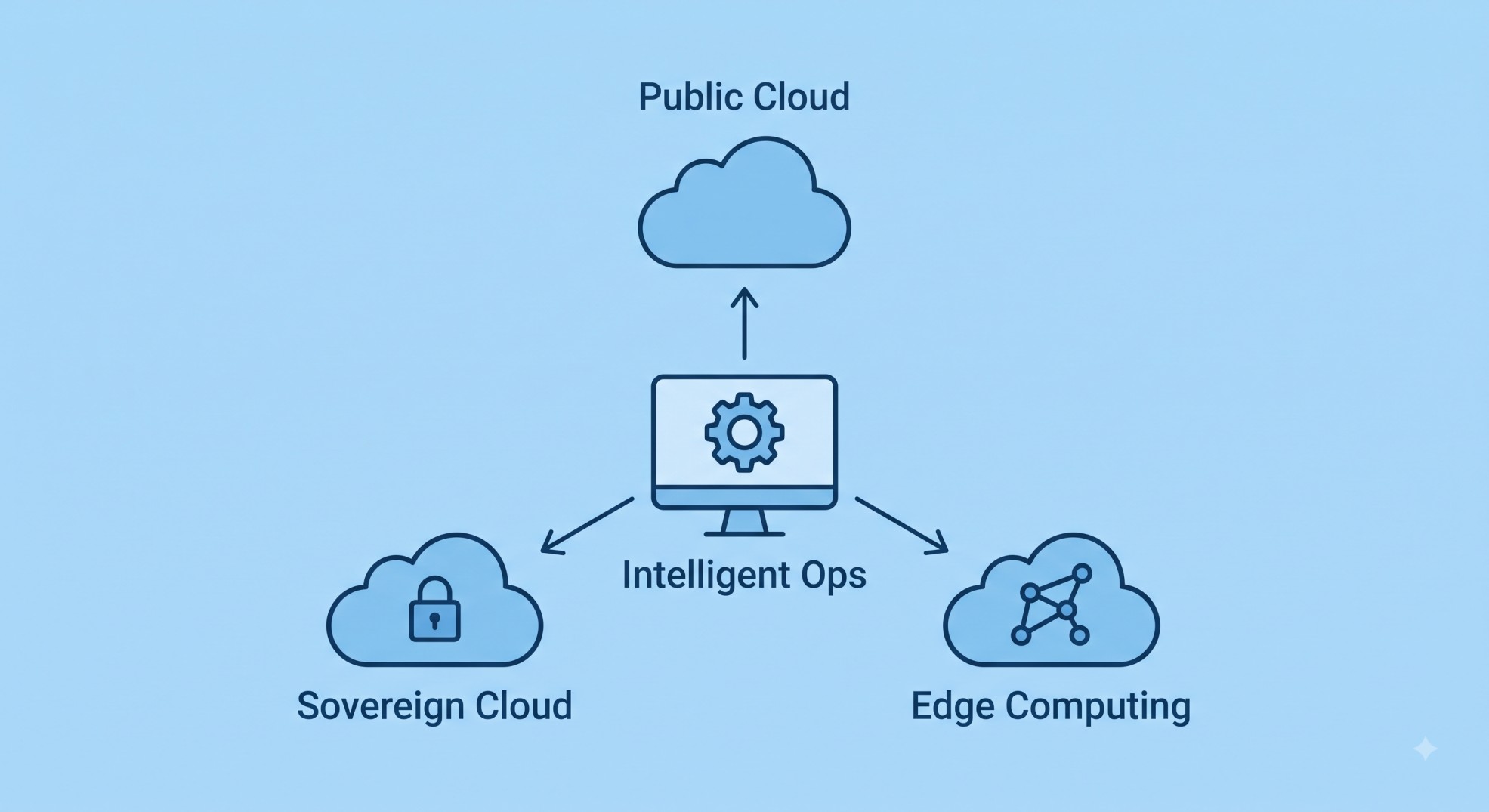
Cloud 3.0 represents a maturation of the ecosystem. It acknowledges that a single, centralized public cloud is no longer sufficient for complex, global enterprises. Cloud 3.0 is characterized by distributed architectures that are secure by design, privacy focused, and highly optimized for specific workloads. Instead of a one size fits all approach, organizations are adopting a balanced, multi tiered strategy. This includes deploying hybrid clouds for flexibility, sovereign clouds for regulatory compliance, and edge computing networks for ultra low latency processing.
The defining mandate of Cloud 3.0 is control. Organizations are reclaiming governance over their data, ensuring that critical assets are not locked within proprietary vendor ecosystems. This shift is heavily accelerated by the rise of enterprise artificial intelligence. Training and deploying advanced Large Language Models requires access to highly sensitive, proprietary corporate data. Boardrooms are no longer willing to expose this intellectual property to public multi tenant environments, necessitating the creation of secure, localized infrastructure.
The Shift to Hybrid and Multi Cloud Ecosystems
The architectural foundation of Cloud 3.0 relies heavily on advanced hybrid and multi cloud deployments. A hybrid cloud combines private, on premise data centers with public cloud services, allowing data and applications to move between them seamlessly.
In 2026, very few enterprise organizations rely on a single cloud provider. Vendor lock in is universally viewed as a critical operational risk. By adopting a multi cloud strategy, engineering teams can route workloads based on performance requirements, cost models, and geographical proximity to the end user. For example, a global retail platform might use one provider for its massive scalable web frontend, a completely different provider for its backend machine learning analytics, and a private data center for its core financial ledger.
This distributed approach allows companies to optimize for burst capacity. During periods of highly volatile traffic, such as global sales events, the private infrastructure can dynamically burst into the public cloud to absorb the load without compromising the security of the primary databases. Workload placement is no longer an afterthought. It is a highly strategic decision managed dynamically by intelligent orchestration platforms like advanced Kubernetes distributions.
Sovereign Cloud Architectures: The Data Residency Imperative
Perhaps the most significant pillar of Cloud 3.0 is the explosive rise of the sovereign cloud. Digital sovereignty is the concept that data is subject to the laws and governance structures of the nation in which it is physically collected and processed. As geopolitical tensions rise and international privacy laws become increasingly strict, data residency has become a board level priority.
A sovereign cloud guarantees that all data, metadata, and operational support infrastructure remain entirely within a specific national border. It prevents foreign entities, and sometimes even the cloud provider themselves, from accessing the information. This is achieved through advanced cryptographic controls, isolated network perimeters, and localized operational personnel.
For organizations operating in regions with strict regulatory frameworks, such as the European Union or highly regulated markets in South Asia, sovereign clouds are no longer optional. They are a legal requirement for doing business. These architectures ensure that citizen data, healthcare records, and financial transactions are completely insulated from international data requests and cross border surveillance programs.
Industry Specific Cloud Environments
As Cloud 3.0 matures, generalized infrastructure is being replaced by industry specific cloud configurations. Major providers and specialized engineering firms are offering platforms that come pre configured with the exact compliance frameworks, security protocols, and data models required by specific vertical markets.
Healthcare Cloud Architectures In the medical sector, cloud environments are designed exclusively around patient privacy and high availability. These architectures feature built in data masking, automated compliance auditing for health regulations, and ultra secure interoperability layers. This allows hospitals to share critical diagnostic imaging and patient histories with specialists instantly while maintaining strict access controls.
Financial and Banking Clouds The financial services industry requires infrastructure capable of supporting high frequency trading algorithms, instant fraud detection, and immutable ledger storage. Financial clouds in 2026 prioritize microsecond latency by pushing compute resources to the absolute edge of the network. They employ continuous zero trust verification, ensuring that every internal and external request is authenticated and authorized before accessing sensitive financial APIs.
Defense and Public Sector Clouds Government operations utilize heavily restricted, physically air gapped sovereign clouds. These environments are completely disconnected from the public internet to prevent sophisticated cyber espionage. They rely on quantum proof encryption standards and are maintained exclusively by personnel with high level national security clearances, ensuring absolute control over classified intelligence operations.
The Rise of Intelligent Ops and AIOps
The physical distribution of infrastructure across hybrid, sovereign, and edge environments creates an ecosystem that is vastly too complex for human engineers to monitor manually. You cannot scale traditional operations teams fast enough to manage millions of dynamic microservices. This complexity has necessitated the evolution of DevOps into Intelligent Ops, heavily powered by Artificial Intelligence for IT Operations, commonly known as AIOps.
Traditional DevOps focused heavily on automation. Engineers wrote static scripts to deploy code, provision servers, and configure networks. However, these scripts were blind. They executed their instructions perfectly, but if the environment changed unexpectedly, the pipeline failed. A human had to read the logs, diagnose the failure, and write a patch.
AIOps introduces contextual awareness, machine learning, and autonomous decision making into the operational lifecycle. It transforms DevOps from a set of rigid, rule based tools into a dynamic, self managing ecosystem. AI agents now analyze massive streams of telemetry data, including logs, metrics, and distributed traces, in real time. They understand the baseline behavior of the system and can act autonomously when anomalies occur.
Autonomous CI/CD Pipelines
The most immediate impact of Intelligent Ops is the transformation of Continuous Integration and Continuous Deployment pipelines. AI is removing the friction from software delivery, creating pipelines that adapt to the code being pushed.
Intelligent Test Selection In legacy systems, a minor code commit might trigger an entire suite of thousands of automated tests, delaying the deployment by hours. Modern AI driven CI/CD platforms analyze the exact lines of code changed in a commit. Using dependency graphs and historical data, the AI mathematically determines exactly which tests are relevant to the change. This reduces testing time by up to eighty percent while maintaining the same level of quality assurance.
Flaky Test Auto Remediation One of the most frustrating aspects of software engineering is dealing with flaky tests, tests that fail intermittently due to network latency or environmental issues rather than actual bugs. AIOps platforms can differentiate between a legitimate code failure and a transient environmental issue. If an AI detects a flaky failure, it will autonomously retry the operation in an isolated container, flag the test for developer review, and allow the pipeline to proceed, preventing pipeline bottlenecks.
Automated Deployment and Rollbacks Deployments are now actively monitored by AI agents. When a new version of a microservice goes live, the Intelligent Ops platform compares the real time performance metrics against the historical baseline. If the AI detects a sudden spike in latency, an increase in memory consumption, or an elevated error rate, it does not wait for a human to acknowledge an alert. It automatically halts the deployment, routes traffic back to the stable version, and isolates the problematic container for deep diagnostic analysis.
Predictive Incident Management
The traditional IT operations model was entirely reactive. A threshold was breached, a dashboard turned red, a pager alerted an engineer at three in the morning, and the team scrambled to find the root cause while the system suffered downtime. Intelligent Ops completely upends this model by shifting to predictive incident management.
AI models continuously ingest telemetry data, searching for subtle patterns that precede a catastrophic failure. For example, an AI might notice a slow, steady increase in memory usage across a cluster of backend servers over a period of weeks, a classic memory leak. Long before the memory exhausts and crashes the system, the AIOps platform will generate a predictive alert.
Furthermore, when incidents do occur, the AI acts as an immediate diagnostic assistant. It parses millions of lines of unstructured log files in seconds, correlates events across different cloud environments, and identifies the exact microservice causing the cascade failure. It presents the engineering team with a plain language summary of the root cause and a generated script to remediate the issue, drastically reducing the Mean Time to Resolution.
AI Integrated Security and DevSecOps
In a distributed Cloud 3.0 architecture, the traditional network perimeter does not exist. You cannot build a firewall around a system that spans multiple public clouds, private data centers, and remote edge devices. Security must be integrated directly into the deployment process, leading to the rise of autonomous DevSecOps.
Intelligent Ops platforms enforce continuous security monitoring. AI agents review infrastructure as code configurations before they are deployed, instantly identifying misconfigurations that could expose data. During runtime, machine learning models monitor network traffic for behavioral anomalies. If a compromised credential is used to access a database in an unusual geographical location at an odd hour, the AI will immediately revoke the access token, isolate the compromised node, and trigger an automated security audit without human intervention.
Cloud FinOps and Autonomous Cost Optimization
One of the largest hidden challenges of migrating to complex multi cloud environments is uncontrolled operational expenditure. Without strict governance, engineering teams often over provision resources, leading to massive cloud computing bills. This challenge has given rise to Cloud FinOps, the practice of bringing financial accountability to the variable spend model of the cloud.
AIOps plays a critical role in modern FinOps. Intelligent agents continuously monitor resource utilization across all cloud environments. They identify idle development servers, unattached storage volumes, and over provisioned databases. The AI can autonomously right size compute instances, seamlessly migrating a workload to a less expensive server type during low traffic periods. By constantly orchestrating the infrastructure based on real time demand, autonomous cost optimization tools can reduce enterprise cloud spending by massive margins, turning FinOps from a quarterly review process into a continuous, automated discipline.
Platform Engineering for the AI Era
To support these intelligent workflows, organizations are investing heavily in platform engineering. Platform engineering is the practice of building internal developer platforms, which are self service portals that abstract away the extreme complexity of Cloud 3.0 infrastructure.
Developers do not want to learn the intricate details of sovereign cloud networking or Kubernetes cluster configuration. They want to write code and deploy it. Internal developer platforms act as the interface between the human developer and the autonomous DevOps systems. A developer requests a new environment, and the platform automatically provisions the secure infrastructure, attaches the AI monitoring agents, configures the FinOps tracking, and sets up the CI/CD pipelines according to strict corporate governance rules.
The Evolving Role of the DevOps Engineer
With AI systems taking over routine deployments, predictive monitoring, and cost optimization, a common question arises regarding the future of the human engineer. In 2026, it is clear that AI is an amplifier for DevOps, not a replacement.
The role of the DevOps engineer is elevating. Instead of writing bash scripts to restart crashed servers, engineers are focusing on high level architectural design, resilience testing, and AI governance. They are designing the parameters and guardrails within which the autonomous systems operate.
The concept of the "human in the loop" remains critical for high stakes operations. While an AI agent can diagnose a vulnerability and draft a security patch, pushing that patch to a live sovereign cloud environment handling financial transactions still requires human validation. Engineers are transitioning into platform orchestrators, managing the fleet of AI agents and ensuring that the automated systems align precisely with business objectives and regulatory constraints.
Preparing for the Autonomous Future
The convergence of distributed Cloud 3.0 infrastructure and Intelligent Ops represents a permanent evolution in enterprise technology. Moving away from centralized cloud providers toward sovereign and hybrid models ensures that organizations retain complete control over their most valuable data. Simultaneously, integrating artificial intelligence deeply into the DevOps lifecycle guarantees that these complex, distributed systems remain highly performant, secure, and cost effective.
Organizations that master this transition will possess a massive competitive advantage. They will operate digital platforms that are inherently resilient to failure, compliant with global regulations by default, and capable of adapting to market demands with zero latency. The future of software engineering lies in building intelligent systems that manage themselves, allowing human creativity to focus entirely on innovation rather than infrastructure maintenance.