
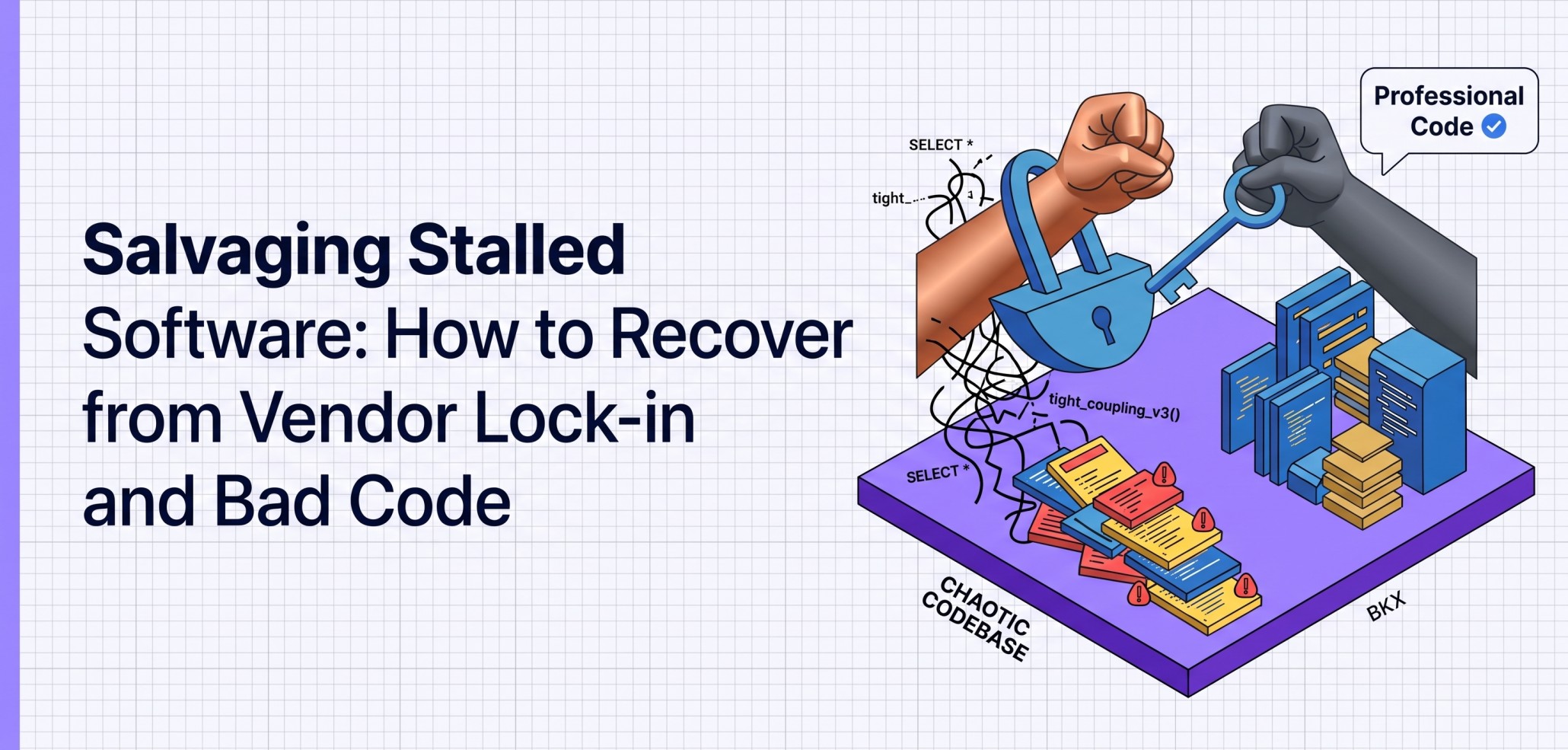
For a founder, CTO, or product owner, few scenarios are as commercially draining, frustrating, or demoralizing as the dynamic collapse of a critical software project due to a failed vendor relationship. After investing significant capital, precious months (sometimes years) of opportunity cost, and substantial organizational trust, you are handed back the "keys to the kingdom"—the final application source code—only to discover that your inheritance is architecturally unsound. You haven't received a viable asset; you've inherited a ticking technical time bomb. The code is a tangled monolith of spaghetti logic, critical security vulnerabilities are integrated into core functions, zero documentation exists, and there is no coherent pathway forward. Your immediate business objectives—scaling to accommodate new user growth, integrating new partnerships, or patching critical customer-facing bugs—grind to a complete and violent halt.
This situation frequently results in a demoralized internal technical team, forced to wade through a "mess" they did not create and which they fundamentally do not understand. In this high-stress environment, the common, purely reactive response from leadership is an impulsive and potentially catastrophic business decision: "The code is garbage. We have to burn it down and rewrite the entire system from scratch."
This article is for the leadership team currently holding that messy codebase. The panic instinct is logical, but it is often mathematically incorrect. A full rewrite is rarely the most efficient or lowest-risk path to recovery. This comprehensive guide will provide a structured, objective framework to diagnose the health of your inheritance, distinguish between salvageable technical debt and terminal code rot, and detail exactly why a forensic codebase audit is the only viable starting point for a professional software rescue operation.
The Invisible Chains: Understanding True Technical Vendor Lock-in
The traditional definition of vendor lock-in is legal or contractual: proprietary service level agreements (SLAs), exorbitant licensing fees, restrictive data portability clauses, or non-compete agreements that make switching vendors operationally difficult. While financially painful, these are solvable business problems managed via legal counsel and corporate restructuring.
The true, insidious lock-in of 2026 is technical lock-in.
Technical lock-in is achieved not by a contract, but by application architecture designed to resist comprehension. It is the technological equivalent of holding the codebase hostage. This strategy is executed by amateur development agencies building systems with zero transparency. It manifests in codebases built with specialized, obscure, or heavily modified proprietary wrappers around standard open-source frameworks (like a "custom CMS" built on top of Laravel but which hides standard Laravel routing), or where the business logic is deliberately obfuscated and tightly coupled.
When an outgoing agency builds your Laravel or React application without adhering to core, standard architectural patterns—like SOLID principles, clean separation of concerns, Inversion of Control (IoC), or Domain-Driven Design (DDD)—they have effectively created an ecosystem that only their internal developers understand. The codebase cannot be easily extended, scaled, debugged, or audited by a new, professional engineering team without a massive, multi-month knowledge transfer process that often yields little actual insight. The logic was never truly sound; it was merely functional in a narrow window. Your previous vendor may have exited the legal agreement, but they maintain absolute operational control over your software's future viability. Your primary business objective must be to break these invisible chains through objective evaluation.
The Rewrite Trap: Why Impulsive Starts are High-Risk Gambles
When a founder is staring at an application where fixing a single minor UI bug requires three days of engineering time, and that simple fix breaks two seemingly unrelated database migrations, the instinctive conclusion is that the entire codebase is worthless. A full, fresh rewrite seems like the only clean solution. It is a seductive fallacy.
Hiring a new team to immediately start a rewrite based solely on the visual functionality of the old application is the single most effective way to guarantee massive cost overruns and delays, often replacing an old architectural mess with a new architectural mess. This phenomenon is known in the industry as "Second-System Syndrome."
The danger of an immediate rewrite is multifaceted.
First, you lose all the invisible edge cases. A messy, legacy codebase contains hundreds of crucial business rules that were discovered, tested, and implemented iteratively over months or years. These rules handle specific scenarios—currency conversions, complex tax calculations, unique user permission hierarchies, or subtle API synchronization logic—that are rarely documented in the original specification. They only exist in that messy code. When you start from a blank slate, you must rediscover every single one of those rules. You won’t discover them until your new, clean system goes live and promptly fails in production, causing user distress and revenue loss. A rewrite is a commitment to repeating past mistakes just to reach parity with what you already have.
Second, the time to parity is immense. While the new team is rebuilding core, existing features, your product cannot ship any new value. You are spending significant capital to remain stationary in a dynamic market. Competitive decay accelerates. If parity takes six months, your competition has had six months to ship new features that you now also have to add to your rewrite specification, turning the project into an unachievable, moving target.
Third, the original specification is almost certainly obsolete. Rebuilding the product from original specifications results in a product that the market no longer wants. The old, messy codebase reflects how users actually used the system, which is far more valuable than a perfect specification from three years ago. If you want to rescue the project, you must first objectively determine what can be saved from the existing investment.
Defining the Mess: Salvageable Technical Debt vs. Terminal Code Rot
Not all bad code is created equal. Understanding the nuance between distinct types of "messy" is crucial for effective decision-making. The generic traffic querying about "salvaging a project" often fails to differentiate between a codebase that is merely outdated and one that is structurally dead. For the frustrated CTO, distinguishing between these two states defines your financial roadmap.
What is Salvageable Technical Debt?
Technical Debt is a natural component of fast software development. It is deferred maintenance. It is not necessarily "bad" code, but rather sub-optimal code that was chosen to speed up a delivery deadline. Technical Debt is salvageable. It is messy, but the core foundation is coherent.
Characteristics of Salvageable Technical Debt include:
Outdated Library Versions: The application is running on an older version of Laravel (e.g., v8 or v9 when v12 is current) but still utilizes standard Laravel conventions.
Missing Docblocks and Comments: The functions and classes are undocumented, forcing engineers to read the implementation logic to understand its purpose, slowing development.
Inefficient (but functional) Database Queries: Large Eloquent queries lack eager loading, causing N+1 query problems that make the application sluggish but consistent.
Lack of Modular Separation: The code is functional, but many business logic pieces live inside Controllers rather than dedicated Service classes. It is "un-refactored" but follows MVC logic.
Minimal Automated Testing: Unit tests exist for core mathematical operations, but large integration or end-to-end (E2E) test coverage is missing.
Salvageable debt requires strategic, planned refactoring. An engineering team can apply the "Boy Scout Rule"—leave the campground cleaner than you found it—cleaning up code blocks as they work on new features, gradually stabilizing the application without halting feature development.
What is Terminal Code Rot?
Terminal Code Rot is the architectural decay that renders a system fundamentally unsafe, operationally volatile, and unmaintainable. It cannot be refactored because there is no coherent logic to refactor. Code Rot often means critical security and stability flaws are the core logic.
Characteristics of Terminal Code Rot include:
Tight Coupling (The Spaghetti Monolith): A single monolithic class handles database connections, User Authentication, Stripe API communication, and View rendering. Modifying the Stripe logic might break User Authentication because the variables are global and state is shared everywhere. There is no separation of concerns.
Hardcoded Configuration: Critical API keys, database credentials, and commercial logic parameters (like pricing tiers) are hardcoded directly into source files rather than environment files, preventing safe deployment across staging and production environments.
Embedded Security Vulnerabilities: Core input handling fails to utilize ORM (Object-Relational Mapping) sanitization defaults, relying on raw SQL queries with unsafe string concatenation, making the entire application vulnerable to SQL injection.
Lack of Idempotency: Critical operations (like creating an invoice or initiating a refund) are not idempotent. Executing the API call twice results in the user being charged or refunded twice, a critical failure of accounting logic.
Zero Architectural Discipline: Business logic lives embedded inside HTML views, global functions contradict each other, and identical data structures are defined multiple times across the application with different parameters.
If your codebase exhibits Terminal Code Rot, a full rewrite is your only safe path. Attempting to refactor this logic is an endless exercise in patching leaks on a sinking ship. You will spend more capital trying to maintain and refactor this mess than you would building a new, stable, and secure system. However, you can still only reach this data-driven conclusion via an objective, professional codebase audit.
The Forensic Codebase Audit: The Essential First Step in Project Rescue
A founder or CTO holding a chaotic codebase from an amateur vendor cannot make an objective financial decision without data. Your outgoing vendor will tell you the code is "fine." A standard new developer or freelancer, looking to maximize their engagement, will tell you it's "all garbage" just to ensure a lucrative full rebuild contract. You require an unbiased, forensic, third-party assessment.
The Forensic Codebase Audit, as executed by specialized agencies like BKX Labs, is an intense, objective, non-intrusive evaluation of your technology asset. The goal is to produce an unvarnished technical assessment of viability, quality, and security, allowing you to build a factual, data-driven recovery roadmap.
A Codebase Audit is not a passive review; it is an active technical probe utilizing five distinct methodologies.
1. Automated Static Analysis and Quality Probing We utilize sophisticated tooling (e.g., PHPStan for Laravel, ESLint and SonarQube) to execute massive-scale, automated analysis of the entire codebase without running the application. This probe maps the complexity of the code, identifying syntax inconsistencies, high cyclomatic complexity (functions that are too mathematically complex to be maintainable), dead code that is never executed, and deprecated function calls that will break in future language updates. We are measuring pure adherence to technical standards.
2. Manual Architectural Review and Separation of Concerns Specialized senior architects manually audit core application files. We are not checking if the code works; we are auditing how it was built. We probe for dependency injection quality, adherence to standard MVC structure, and the presence of specialized architectural patterns (like Service, Repository, or Factory patterns). We specifically map tight coupling, locating areas where commercial logic is embedded in the UI layer, which is a key indicator of Terminal Rot.
3. Third-Party Dependency and Vulnerability Scanning An application is only as secure as the libraries it relies upon. Amateur vendors often utilize outdated, unpatched, or "abandonware" libraries. We run comprehensive security scans (utilizing tools like Snyk or local CVE databases) against the entire dependency tree. This probe identifies every library version with a known critical security flaw (e.g., outdated OpenSSL wrappers or vulnerable cryptographic primitives). A high volume of critical, unpatched dependencies is a significant indicator that the previous vendor prioritized speed over baseline software security.
4. Database Schema Health and Normalization Evaluation We audit the raw database schema and migration history. A clean codebase must be supported by a relational database schema that adheres to basic normalization rules (at least 3NF). We probe for missing database indexes (the primary cause of application sluggishness), inefficient data types (e.g., storing dates as strings), and lack of foreign key constraints, which inevitably leads to data corruption over time.
5. Process and Infrastructure (DevOps) Maturity Audit How an application is built and deployed is as important as the code itself. We evaluate the deployment pipeline maturity. Does a CI/CD (Continuous Integration/Continuous Deployment) pipeline exist? Are code changes automatically validated via linting and testing hooks before merging? Is the staging environment an identical replica of production? A robust DevOps process allows even Technical Debt to be managed safely. An application that is manually FTP'd to a live server by a solo freelancer is operationally volatile by definition.
The Deliverable: An Objective Technical Viability Score The result of this 7-10 day forensic audit is not just opinions. It is a comprehensive Technical Audit Report. BKX Labs provides a quantifiable Technical Risk Score, a prioritized matrix of critical security and stability vulnerabilities that require immediate patching, and a binary recommendation: Salvage/Refactor or Terminal/Rewrite. This report transforms your crisis from an emotional debate into a clear, data-driven strategic operational plan.
The Salvage Roadmap: Refactoring Over Rewriting (When Salvageable)
If the Forensic Audit confirms that your mess is primarily salvageable Technical Debt and not Terminal Code Rot, the correct strategic path is incremental refactoring. A professional software rescue operation does not halt feature development; it stabilizes the existing foundation while delivering incremental business value.
The Salvage Roadmap must follow a strict prioritization framework based on minimizing future risk rather than maximizing feature throughput.
Phase 1: Stabilization and Security Patching (Critical Priority) Before touching business logic, the application must be stabilized. This phase involves immediate patching of all CVE (Common Vulnerabilities and Exposures) alerts identified in the dependency scan. We implement standard environment configurations to ensure credentials are never hardcoded. We install a robust automated error tracking platform (e.g., Sentry) to move beyond "user reports bug" to "monitoring alerts engineer of exception." Stabilizing the infrastructure ensures your rescue attempts do not cause new system failures.
Phase 2: Implementing a Testing Harness and Characterization Tests You cannot refactor code if you do not understand what it does. However, documenting the logic first takes too long. A professional rescue team utilizes characterization testing. We write automated tests around the existing messy code block, essentially telling the system: "I don't care how you calculate this complex tax rate, but when I input X, you must output Y." We lock down the output behavior of the messy code before we attempt to change its internal structure. This testing harness is your insurance policy against regression errors during refactoring.
Phase 3: Tactical Refactoring and Technical Debt Retirement With the behavior locked down, we begin surgical refactoring. We adhere strictly to the "Strangler Fig" pattern: we leave the old messy function in place, write a new, clean Service class implementation of the logic, wrap the old logic with tests, and gradually point the controllers to use the new Service.
During this phase, we apply key refactoring techniques:
Dependency Injection: We swap global variables and tightly coupled object creation for dependency injection interfaces.
Eager Loading: We fix N+1 query problems in the database layer.
SOLID Compliance: We break massive classes that handle too much into single-responsibility classes.
Core Version Upgrades: We iteratively upgrade the core framework versions (e.g., Laravel 8 to Laravel 12) step-by-step.
This tactical approach allows feature development to resume at about 50% capacity within 14 days of standardization, utilizing the other 50% for debt retirement. Within 90 days, the technical debt should be minimized to an operational baseline, and feature velocity should recover to standard, professional levels without suffering a catastrophic outage.
Conclusion: Data First, Decision Second
For a stressed CTO or founder holding a stalled project and an inherited, chaotic codebase, your failure wasn't the code. Your previous vendor was the failure. Your subsequent failure would be making an multi-month, multi-thousand dollar business decision based on stress and emotion rather than professional engineering data.
Don't panic start a high-risk full rewrite that will almost certainly cost more and take longer than planned. Don't waste capital tasking new engineers or freelancers to "try and fix it" without an objective plan.
Contact a specialized software rescue agency like BKX Labs for a Forensic Codebase Audit. For a relatively minor fixed investment, you will receive an objective, technically exhaustive report defining exactly what can be salvaged. Make a data-driven choice to either refactor strategically or execute a clean rewrite based on fact, and position your application for professional stability, security, and growth. Data must lead; code will follow.