
The Collapse of Perimeter Defenses
The global cybersecurity landscape in 2026 has reached a critical inflection point. With the annual cost of cybercrime projected to hit 10.5 trillion dollars, operational resilience is no longer a localized IT concern. It is the defining, non negotiable capability for modern enterprises. The integration of autonomous artificial intelligence by malicious actors has exacerbated systemic risks. Traditional firewall and protocol based perimeter defenses have failed comprehensively, necessitating a fundamental restructuring of enterprise security.
For decades, corporate security relied on a castle and moat methodology. Organizations built robust external firewalls and assumed that any entity inside the network perimeter was inherently trustworthy. This architecture fails categorically in the era of Cloud 3.0, remote workforce distribution, and interconnected supply chain application programming interfaces. When a single compromised vendor credential can grant a threat actor lateral movement across an entire corporate database, perimeter defense becomes a liability.
Furthermore, modern threat actors utilize machine learning to generate highly sophisticated, contextually accurate phishing campaigns that bypass static email gateways. Once inside, they deploy ransomware that executes too rapidly for human security analysts to intercept. This reality requires a shift from reactive defense to proactive, mathematically secure infrastructure.
Architecting Zero Trust Environments
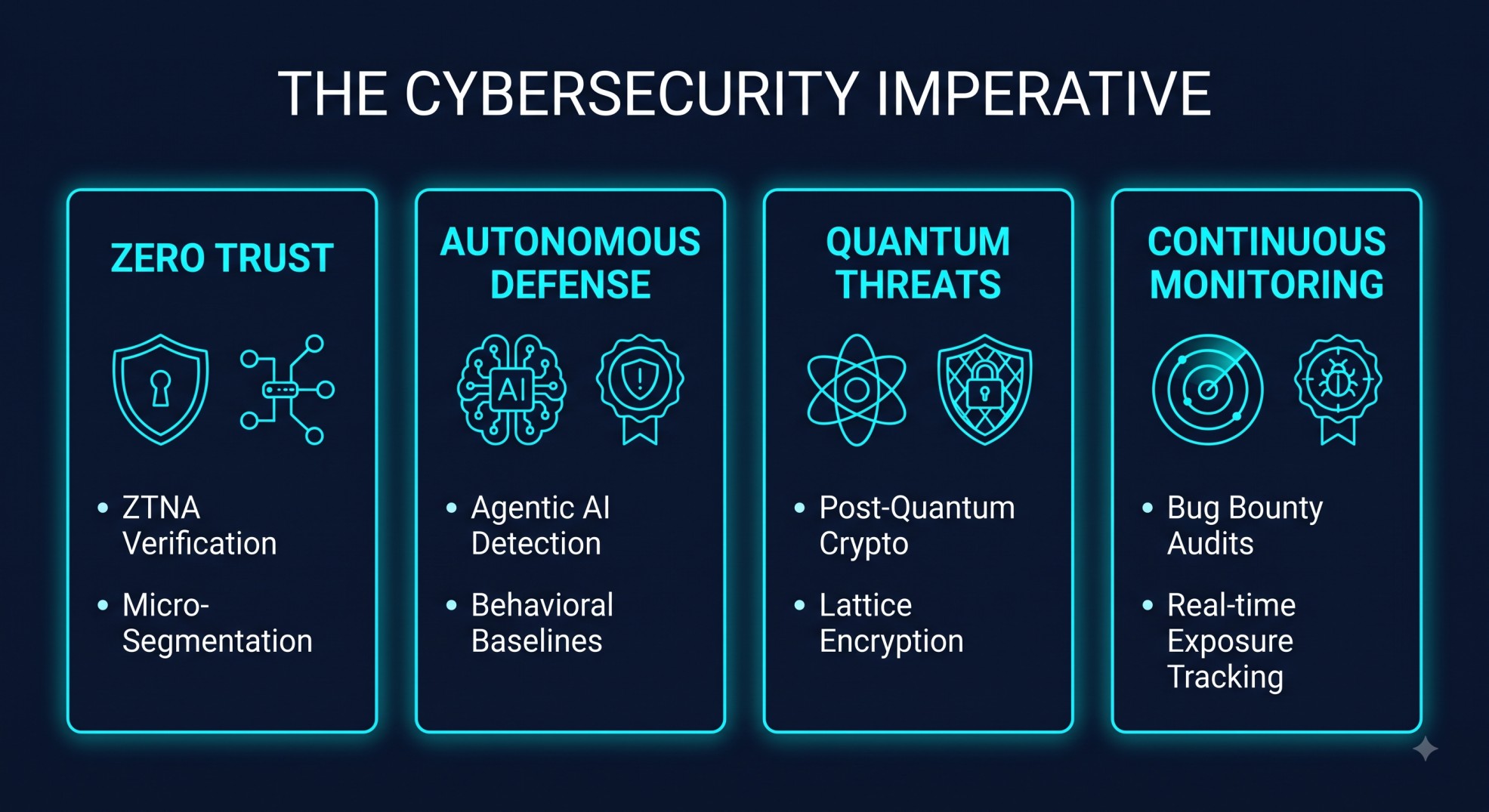
The foundational philosophy of modern cybersecurity is the Zero Trust Architecture. Zero Trust operates on a single, uncompromising principle: never trust, always verify. It mandates strict identity verification, device posture checks, and contextual authorization for every single access request, regardless of whether that request originates from a public network or a hardwired terminal inside corporate headquarters.
Transitioning to Zero Trust requires replacing legacy Virtual Private Networks with Zero Trust Network Access. A traditional VPN grants broad, unrestricted access to the internal network once a user authenticates. ZTNA, conversely, creates a secure, encrypted tunnel only to the specific application or microservice the user is explicitly authorized to access. If the user device exhibits anomalous behavior, such as a sudden lack of an active endpoint detection agent or an unusual geographical login, the ZTNA gateway instantly terminates the connection.
Micro segmentation is another critical pillar of this architecture. By dividing the network into isolated, secure zones, security teams restrict lateral movement. If a threat actor breaches a low level marketing server, micro segmentation ensures they cannot pivot to the financial ledger or the customer data repository. Every zone boundary requires continuous cryptographic authentication, treating internal traffic with the same suspicion as external traffic.
Autonomous Threat Detection and AIOps
As enterprise networks scale infinitely into hybrid cloud environments, the volume of telemetry data generated vastly exceeds human cognitive capacity. Traditional Security Information and Event Management systems rely on static rules and signature based detection. They flag known malware hashes or specific, historically documented attack vectors. However, they are completely blind to novel, zero day exploits generated dynamically by offensive AI tools.
To combat this, enterprises are deploying autonomous threat detection systems powered by Agentic AI. These systems do not rely on outdated signatures. Instead, they utilize unsupervised machine learning to establish a highly accurate baseline of normal network behavior. They understand the typical traffic volumes, the standard working hours of specific employee cohorts, and the normal data transfer patterns between microservices.
When an anomaly occurs, such as a high volume database export initiated by a service account at an unusual hour, the autonomous security agent does not merely generate a dashboard alert. It takes immediate, autonomous action. Within milliseconds, the AI isolates the compromised host from the network, revokes the associated authentication tokens, and captures the volatile memory state for forensic analysis. This structural change shifts the Security Operations Center from a reactive alerting team to a proactive governance board that reviews the autonomous actions taken by the AI.
The Quantum Computing Threat and Q Day
Beyond the immediate threat of AI driven attacks, the looming shadow of mature quantum computing is forcing immediate infrastructural changes across the globe. Quantum computers operate on qubits, leveraging quantum superposition and entanglement to perform complex calculations exponentially faster than classical computers. While highly beneficial for material science and medicine, this computing power poses an existential threat to global data security.
The primary concern is Shor's algorithm. When run on a sufficiently powerful quantum computer, Shor's algorithm can factor massive prime numbers in seconds. This mathematical capability fundamentally breaks RSA encryption and Elliptic Curve Cryptography, the cryptographic standards that currently secure all global internet traffic, banking transactions, and secure enterprise communications.
The exact date when a cryptographically relevant quantum computer will come online is known in the industry as Q Day. While Q Day may be several years away, the threat is immediate due to harvest now, decrypt later attacks. Nation state actors and elite cyber syndicates are currently intercepting and storing massive volumes of encrypted, high value enterprise and government data. Their strategy is to hold this encrypted data on highly secure servers until quantum computers are mature enough to decrypt it retroactively. For data with a long shelf life, such as intellectual property, military intelligence, and healthcare records, the quantum threat is already a present reality.
Adopting Quantum Proof Encryption
To secure data against both current and future threats, organizations must rapidly transition to Post Quantum Cryptography. PQC algorithms are uniquely designed to be executed on classical computers but are mathematically resistant to quantum decryption methods.
The National Institute of Standards and Technology has formalized the first set of PQC standards for global enterprise adoption. Enterprise architects must focus on integrating algorithms like CRYSTALS Kyber for secure key encapsulation mechanisms and CRYSTALS Dilithium for secure digital signatures. These modern algorithms rely heavily on lattice based cryptography. Unlike RSA, which relies on the difficulty of factoring prime numbers, lattice cryptography involves finding the shortest vector in a complex, multi dimensional grid. This is a mathematical problem that remains exponentially difficult even for advanced quantum algorithms.
Implementing PQC requires absolute crypto agility. Organizations can no longer hardcode cryptographic libraries deep within their application source code. Crypto agility allows engineering teams to swap out cryptographic primitives rapidly via central configuration management without rewriting core application logic. This architecture ensures that as new quantum resistant standards evolve, the enterprise infrastructure can adapt seamlessly without suffering massive operational downtime.
Continuous Monitoring and Attack Surface Management
A static security posture is a vulnerable security posture. With the rapid deployment of decentralized finance platforms, smart contracts, and dynamic cloud applications, the enterprise attack surface is constantly expanding and shifting. Continuous Threat Exposure Management is mandatory for survival in 2026.
Automated vulnerability scanners are insufficient for identifying complex logical flaws in custom software. Organizations are increasingly relying on continuous crowdsourced security models, specifically Bug Bounty programs. Platforms like HackerOne connect enterprises with a vetted, global community of elite ethical hackers. By offering direct financial incentives for responsible disclosure, companies ensure their attack surface is continuously probed by the exact same offensive techniques utilized by actual adversaries.
For organizations developing blockchain and decentralized finance solutions, smart contract auditing must be integrated directly into the continuous integration pipeline. Smart contracts are immutable once deployed to the mainnet. A single logical flaw can result in the instantaneous drain of millions of dollars in digital assets. Continuous monitoring in this sector involves deploying specialized AI agents that monitor decentralized ledgers for anomaly transactions, flash loan attacks, and liquidity pool manipulation in real time, allowing organizations to pause protocols before catastrophic losses occur.
Strategic Integration for Enterprise Leaders
The cybersecurity imperative of 2026 demands a complete architectural overhaul. Chief Information Security Officers and technical founders must pivot from buying fragmented security tools to architecting cohesive, autonomous defense ecosystems.
The transition begins with a comprehensive audit of existing cryptographic assets and the immediate deprecation of legacy VPNs in favor of Zero Trust Network Access. Simultaneously, organizations must deploy Agentic AI monitoring tools to secure their hybrid cloud environments against automated zero day attacks.
Building operational resilience is no longer about attempting to prevent every possible network breach. It is about architecting a system that assumes a breach has already occurred, continuously verifies every identity, and autonomously isolates threats before they can compromise mission critical data. By embracing strict Zero Trust frameworks, autonomous AI defense mechanisms, and quantum proof cryptography, software enterprises can secure their digital infrastructure against the most sophisticated and destructive threats of the coming decade.