
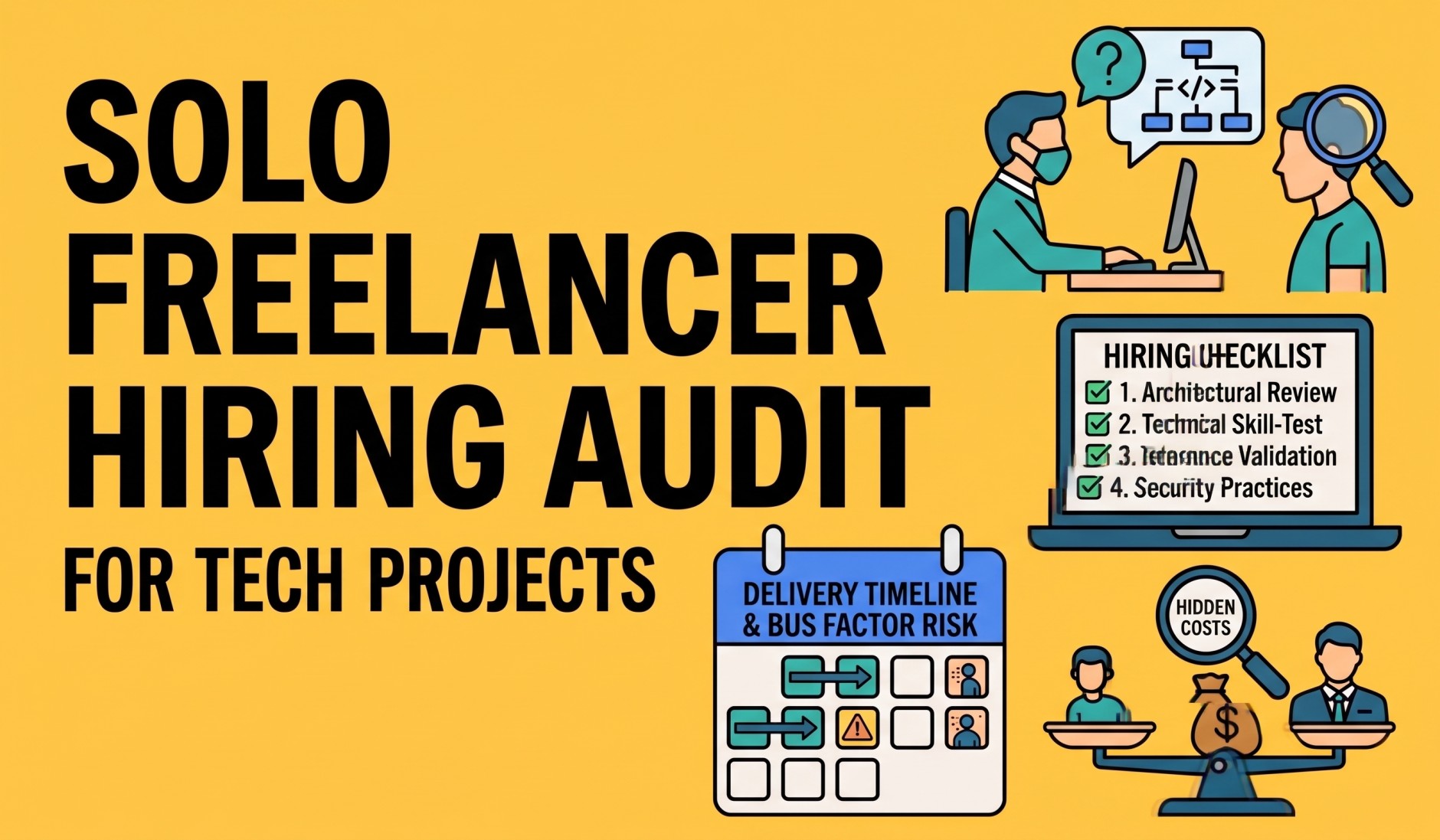
In the aggressive, high-stakes ecosystem of software development in 2026, the demand for immediate technical intervention has never been higher. When a critical application hits a scaling wall, exhibits terminal code rot, or a previous vendor relationship collapses, founders and CTOs find themselves paralyzed by the urgency of project rescue. The primary impulse is speed: "We need someone to fix this, now."
In this reactive environment, the solo freelancer emerges as the most immediate, accessible, and seemingly cost-effective solution. The gig economy is vast, and a specialized expert is always only a search query away. For many stressed non-technical founders, hiring a solo freelancer feels like the efficient, "Lean Startup" path to victory.
However, the reality of project rescue is rarely efficient, and almost never simple. At BKX Labs, having audited and salvaged hundreds of stalled applications, we approach the "solo operator" decision not with ideological bias, but with forensic pragmatism. This analysis will move far beyond generic hiring advice. We provide a deep, methodological audit of when a solo freelancer is a surgical asset, and precisely where their structural limitations transform into catastrophic operational risks for your enterprise.
The Strategic Sweet Spot: When the Solo Freelancer is the Correct Decision
The short summary that often floats around generic traffic is true: solo freelancers are excellent for "discrete, low-complexity tasks or prototypes with short timelines." But what do those terms actually mean in a professional engineering context? And why does a single individual excel here?
The core advantage of the solo freelancer is minimized communication overhead. In a dedicated team or agency (like BKX Labs), a project passes through a structured process involving product managers, QA engineers, frontend and backend specialists, and architects. This guarantees quality, but it requires coordination. A freelancer, conversely, is a single cognitive unit. The communication loop from "requirement" to "code commit" is instant and linear.
When complexity is low, this overhead is useless. When a timeline is extremely short, this coordination is too slow.
Use Case A: The Discrete, Low-Complexity Polish
A "discrete" task is self-contained. It has clear entry and exit points and minimal dependencies on the wider codebase. These are not "features" so much as "patches" or "polishes."
Conversion Optimization Patch: A founder knows they are losing 15% of users at the final checkout step due to a confusing, multi-stage form in their Laravel application. The requirement is to consolidate this form into a streamlined, single-step interface utilizing standard React components.
Legacy Bug Remediation: The application crashes only when a user from a specific geographic region attempts to download a CSV report generated via a 3rd party API. The core logic of the application is stable, but this niche bug requires deep debugging of the specific library responsible for the export.
Internal Tooling CRUD: The business team requires a basic CRUD (Create, Read, Update, Delete) interface to manage internal pricing tiers that are currently stored in a JSON file in the backend.
For these tasks, hiring a full team is over-engineering. A specialized solo freelancer (e.g., a Laravel expert) can clone the repository, locate the relevant file, apply the fix, and submit a pull request within 72 hours, optimizing both speed and capital.
Use Case B: The Non-Scalable, Short-Timeline Prototype
The distinction between a prototype and an MVP (Minimum Viable Product) is crucial. A prototype is a visual simulation or a basic, non-scalable realization of an idea meant to prove a single concept or win stakeholder buy-in. It is, by definition, built to be thrown away.
AI Integration PoC: A SaaS founder wants to see if integrating an LLM API to summarize user comments will add value. They need a basic React dashboard that calls the OpenAI API and displays the output.
Stakeholder Demo: A non-profit needs a clickable visual model of their intended mobile application to present to a granting board, where production scalability is explicitly not the priority.
In these scenarios, speed is the only metric that matters. A freelancer can utilize sub-optimal libraries, skip testing entirely, ignore database indexing, and deploy via FTP directly to a staging server. They are creating a temporary marketing asset, not building a foundational asset. For this purpose, they are the single most efficient resource.
The Methodological Void: Where the Lack of Process Cripples Project Rescue
The danger of the solo freelancer is not their individual lack of intelligence or skill. The danger is structural. Their environment lacks the necessary "guardrails" that professional software engineering requires.
In the introduction to this topic, the core warning is "Lack of process, limited accountability, and high 'bus factor'." To understand the risk, we must drill down on what "process" means in a mature development ecosystem, and what its absence entails during a project rescue.
1. The Proliferation of "Blind" Automation and CI/CD Absence
A professional operation treats the CI/CD (Continuous Integration/Continuous Deployment) pipeline as a non-negotiable safety check. Every code commit is automatically validated. Tests must pass, security vulnerabilities must be scanned, and the build must succeed before any code reaches a staging or production server.
A solo freelancer, prioritized for speed, often operates without these hooks. Code is merged, and deployment is done manually or via a basic script. The risk of regression errors (fixing one bug and breaking five others) skyrockets. Without automated checks, a freelancer can unknowingly commit breaking changes to a mission-critical function, only discovered weeks later by a frustrated user.
During project rescue, where the codebase is already fragile, the introduction of unverified, blind commits is reckless.
2. The Absence of the "Second Pair of Eyes": Why Code Reviews Matter
The single most valuable quality gate in software engineering is the code review. Even the most brilliant senior architect makes mistakes, utilizes sub-optimal patterns, or forgets to sanitize an input. A standard professional workflow mandates that no code reaches production without a peer review.
A solo freelancer has no peers. Their perspective is the entire application's reality. There is no one to point out that their database query pattern will scale terribly when traffic doubles. No one to flag that they are utilizing a deprecated, unsafe function in the authentication controller. During project rescue, where the application’s integrity is already compromised, allowing an operator to deploy unverified, un-reviewed code is simply amplifying the original problem.
3. Documentation decay and "Franchise" Problem
Software is not built; it is grown. A project that scales requires a coherent, written manual of its architectural decisions, its dependency graphs, and its data normalization rules. Without this, the software cannot be inherited or scaled.
Freelancers, working solo and quickly, rarely document. Their knowledge of why they made a decision lives only in their internal memory. This creates the "Franchise Problem." While a full team at an agency like BKX Labs builds a system that anyone can read, understand, and reproduce, a solo freelancer builds a specialized application that only they can manage. You are not building a resilient asset; you are building a new dependency on a single individual.
The Critical Risk Factor: Understanding the Limited Accountability Horizon
When complexity increases or when something goes catastrophically wrong—which is guaranteed during a complex project rescue—the dynamic between an agency and a freelancer changes fundamentally. This shift is defined by the concepts of operational liability and contractual accountability.
Trust vs. Legal Recourse
When you engage a professional agency, you are engaging a corporate entity backed by professional liability insurance, detailed Service Level Agreements (SLAs), and established legal protocols. The agency has a brand reputation to uphold and a commercial infrastructure designed to manage risk. When a project goes off the rails, you do not rely on "niceness"; you rely on contractual mechanisms for remediation, penalty clauses, or knowledge transfer mandates.
When you engage a solo freelancer, accountability is a trust-based ecosystem. While many freelancers are highly ethical and professional, your legal recourse when they disappear is practically non-existent. Suing a solo individual in small claims court for a $5,000 breach of contract, while also fighting an ocean apart legally, is a futile business action. The transaction cost of remediation often exceeds the original project value.
This accountability gap manifests in distinct operational dangers:
The "Ghosting" Phenomenon
The single most common complaint regarding freelancers is "ghosting." The freelancer stops responding to emails, messages, and calls.
This isn't always malicious. Freelancers face immense personal, financial, and mental health volatility. A family emergency, severe burnout, or a sudden change in life priority (like moving countries) can cause them to halt their entire commercial operation without notice. Because there is no organization to manage the handoff, the project simply dies. If this happens mid-rescue, your investment is vaporized.
Scope Creep without recourse
During project rescue, the original specification is almost always obsolete. A professional team manages this reality via Change Request orders, impacts analysis reports, and rigorous prioritization sessions with the product owner.
A freelancer often handles scope creep dynamically. This appears efficient initially, but it quickly leads to uncontrolled development. Without a project manager acting as the governance layer, the freelancer might spend three weeks optimizing a non-critical feature while the core security vulnerability remains open. Accountability is lost because there is no governance structure to enforce strategic priorities.
The Users as QA: Limited Quality Assurance
In a standard team structure, a developer builds, and a Quality Assurance (QA) engineer attempts to break the implementation. They write comprehensive automated integration tests and perform manual E2E (End-to-End) testing.
A solo freelancer is their own QA. This is fundamentally biased. No one can objectively test their own implementation against all edge cases. During a project rescue, this lack of validation ensures that bugs are not caught by an engineer; they are caught by your users in production. Your brand takes the reputational damage while the freelancer attempts, reactive-style, to fix the issues they introduced.
The Project Rescue Catastrophe: Deconstructing the "High Bus Factor"
The rövid summary that introduces this topic contains perhaps the single most dangerous phrase for any project in crisis: "high 'bus factor' (project halts if they disappear)." To technical founders, "Bus Factor" is a fundamental operational metric of catastrophic risk.
The Bus Factor of a project is the number of team members that must be hit by a bus before the project cannot be completed or maintained. If your project relies entirely on a single solo freelancer, your project’s Bus Factor is exactly one.
This risk is amplified exponentially during a project rescue, where stability is compromised, and knowledge is scarce. Relying on a solo individual during this time is not a strategic risk; it is an irresponsible gamble with your enterprise’s viability.
The Multi-Faceted "Disappearance"
"Hit by a bus" is a dramatic metaphor, but the actual risk factors are mundane, frequent, and just as destructive. A freelancer doesn’t need a physical catastrophe to cause total project failure.
Mental Health and Burnout: Freelancing is inherently volatile, isolating, and high-stress. Managing scope, deadlines, and collections alone can lead to severe burnout, causing the individual to abruptly halt their entire operation.
The "Full-Time" Lure: The single biggest risk to your freelancer is a competing full-time offer. In the volatile gig economy of 2026, a stable enterprise job with comprehensive benefits and a predictable salary is extremely tempting. The day your mission-critical freelancer accepts a "secure" role is the day your rescue operation halts, as their priorities and bandwidth disappear overnight.
Life Events: A personal health emergency, a divorce, a family crisis, or a simple change of geographical location can cause a solo freelancer to prioritize life over contract logic. They have no team to absorb the shock, so the shock is absorbed entirely by your stalled software.
Terminal Knowledge Loss
When a solo freelancer disappears, your project doesn't just stop; it loses its internal memory. The specific details of that complex database synchronization logic, the intricate payment processing webhooks, or the niche reason they bypassed standard authentication logic... that knowledge lives exclusively in their memory.
If they did not document (and they rarely do), their departure guarantees terminal knowledge loss. Your next engineering team will spend months performing a technical autopsy on the code just to understand what was done. In a rescue scenario, this delay can cause irreversible user churn and revenue death.
The Specialization Trap: Siloed Development vs. Holistic Systems Rescue
The final warning from our starting point is that a solo freelancer "often specializes only in frontend or backend, not both." This highlights the difference between specialized coding and full systems engineering. Modern software rescue requires the latter.
Amateur development, which leads to stalled projects, almost always suffers from a critical imbalance.
The "Frontend-First" Trap: A previously hired solo freelancer (likely a React expert) built a beautiful, fluid, single-page application (SPA). It "looks" great, but it is built on top of a shallow, slow, un-optimized backend built with minimal PHP.
The "Backend Monolith" Trap: Another freelancer (perhaps a senior Laravel or Node.js expert) built a robust, scalable, complex backend architecture with impeccable database normalization. It’s powerful, but the React frontend they "hacked together" is buggy, non-responsive, and un-optimized. It scales perfectly, but no user can use it.
Project rescue is fundamentally about restoring balance. If your previous software stalled because of a toxic frontend mess, hiring another solo frontend freelancer is iterating on the same fundamental problem.
Restoring an application requires a holistic audit and immediate, coordinated intervention across both layers: stabilizing the backend data architecture while refactoring the frontend view layer to utilize standard, maintainable patterns.
A solo freelancer, prioritized for speed, will focus only on their specialization silo. They will build a "good" feature in a "bad" system, merely increasing the future complexity and technical debt of the stalled application. Systems rescue requires a cohesive, interdisciplinary team that communicates instantly and can iterate across the entire technology stack in parallel. A solo freelancer, by definition, can only do one.
Conclusion: Data First, Decision Second
For a founder or CTO holding a stalled software project and an inherited, chaotic codebase, your failure wasn't the code. Your previous vendor was the failure. Your subsequent failure would be making another multi-month, multi-thousand-dollar business decision based on stress and emotion rather than forensic operational data.
When evaluating a solo freelancer, you cannot look at their individual intelligence or skill. You must look at their methodological environment.
A solo freelancer is a high-speed scalpel. They are excellent for precision intervention on a discrete, low-complexity task, or for building a temporary prototype. Use them for that purpose, and you will optimize both capital and speed.
However, a scalpel is not the tool for major surgical reconstruction of a complex, failing patient.
If your application suffers from terminal code rot, high volatility, scaling death, or an incomplete security layer, a solo freelancer represents the single biggest operational risk you can introduce. Their methodological void, high 'bus factor', limited accountability, and specialization silos guarantee that their intervention will be reactive rather than resilient.
You require a forensic software rescue operation, not a coder. Contact a specialized agency like BKX Labs for an objective, comprehensive Codebase Audit. For a relatively minor fixed investment, you will receive an exhaustive report defining exactly what can be salvaged. Make a data-driven choice to either refactor strategically or execute a clean rewrite based on fact, and position your application for professional stability, security, and growth. Data must lead; code will follow.