
The enterprise artificial intelligence landscape has reached a definitive tipping point. The era of experimental pilot programs and conversational novelties has concluded, giving way to production-grade autonomous systems. For years, organizations focused on Generative AI capabilities, leveraging large-scale models to summarize documents, draft copy, or produce code snippets on demand. While valuable, Generative AI remains inherently reactive: it requires constant human direction, prompt engineering, and step-by-step oversight.
The focus of enterprise technology has shifted decisively toward Agentic AI. Rather than simply generating text or media in response to a discrete prompt, Agentic AI systems possess the autonomy to plan, execute multi-step workflows, interface with external software ecosystems, and adapt to changing conditions in real time. This evolution transforms artificial intelligence from a passive assistant into an active operational force capable of driving complex business processes independently.
Generative vs. Agentic Paradigms
To understand this structural shift, engineering teams must evaluate the underlying differences in how these systems process and act on information.
Generative AI operates through a direct input-output loop. A human user provides a prompt, the Large Language Model processes the token sequence, and the system predicts the most statistically probable completion. The transaction ends immediately upon response delivery. If the output requires further refinement or implementation, the responsibility falls back on the human operator to provide follow-up instructions or copy the code into a live environment.
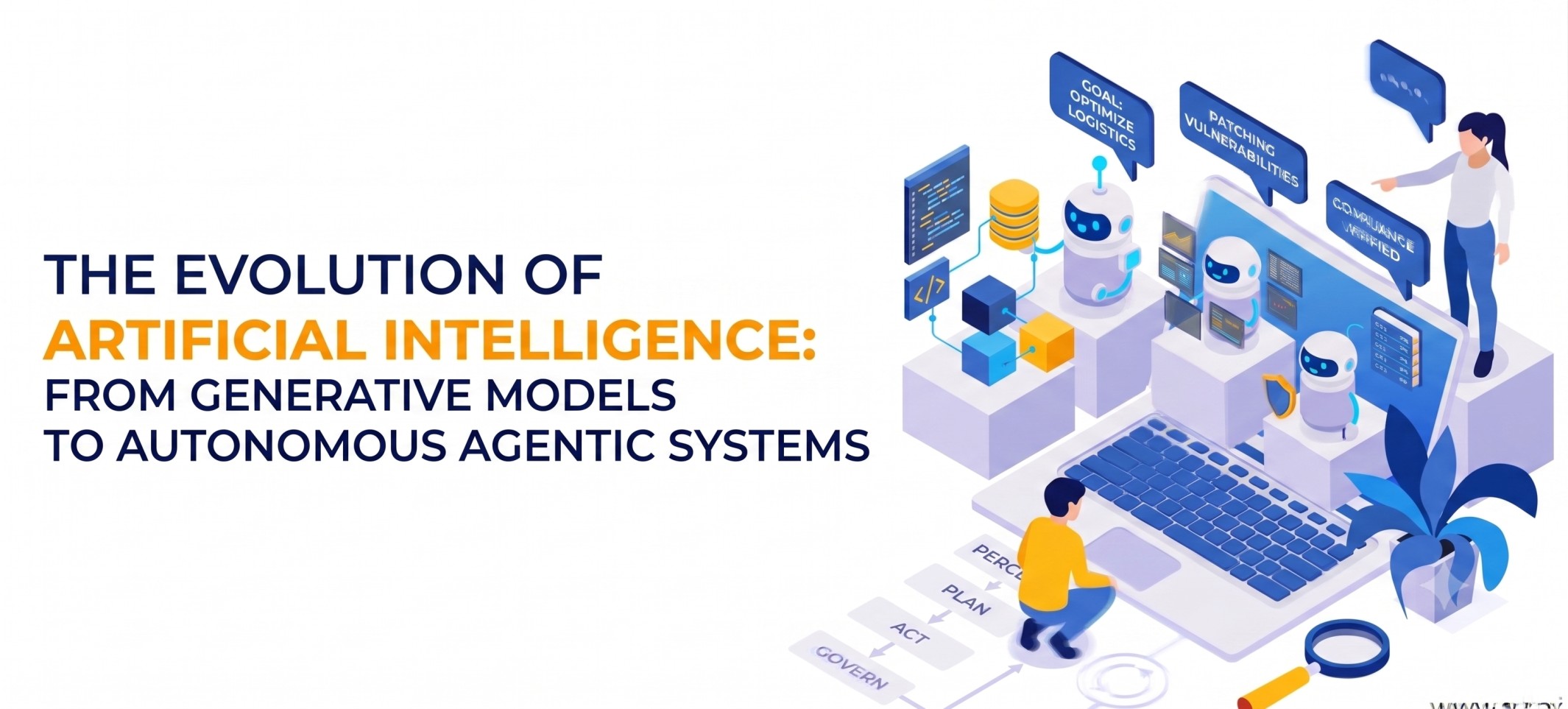
Agentic AI introduces a continuous perceive-plan-act loop. When given a high-level goal, an agentic framework breaks the objective down into discrete subtasks, creates an execution strategy, evaluates its internal confidence, and executes actions sequentially. If a subtask fails or returns an unexpected error code, the agent analyzes the failure, modifies its tactical approach, and attempts an alternative solution without waiting for human intervention.
Architectural Foundations of Agentic Frameworks
Building robust agentic architectures requires a decoupled system design where the Large Language Model functions primarily as the cognitive engine rather than the entire application logic.
The Foundation Layer The central model provides natural language understanding, intent classification, and logical reasoning. It processes raw inputs and formulates structured JSON commands or function calls.
Memory and State Management Unlike standard chat interfaces that lose context outside their immediate window, agentic systems utilize persistent vector memory and temporal state tracking. This allows the system to maintain operational awareness over extended time horizons, tracking project progress across hours, days, or weeks.
Tool Integration and API Orchestration Agents derive their utility from their ability to interact with the external world. Through standardized API hooks, model-context protocols, and custom function definitions, agents execute shell commands, query SQL databases, send HTTP requests, and manipulate third-party software like CRMs or ERPs.
Dynamic Planning and Self-Correction Before executing any code, the system runs through a planning phase, often utilizing tree-of-thought or chain-of-thought methodologies. If a database query fails or an external server returns a 500 error, the agent captures the stack trace, adjusts its request parameter, and re-executes the call.
The Rise of Self-Assembling Software
As agentic workflows mature, the software development lifecycle itself is undergoing a fundamental restructuring. Traditional development relies on human engineers manually converting business specifications into static source code. In contrast, modern platforms are pivoting toward intent-driven development.
In an intent-driven model, software engineers define high-level system requirements, data boundaries, and performance benchmarks. Agentic systems then handle the underlying construction, generating backend services, configuring database schemas, setting up continuous integration pipelines, and writing complete unit test suites autonomously.
Beyond initial deployment, these systems give rise to self-healing software ecosystems. When a runtime exception occurs in production, an agentic monitoring service isolates the fault, traces the execution stack, writes a patch in a sandboxed staging environment, runs the automated test suite to verify the fix, and submits a pull request complete with root-cause analysis documentation. This capability drastically reduces downtime and allows human development teams to focus exclusively on core architectural choices.
Industry-Specific Agentic Implementations
The practical deployment of agentic architecture varies significantly based on regulatory constraints and domain complexities across vertical markets.
Aerospace and Defense In highly regulated defense manufacturing, Generative AI was previously limited to summarizing technical manuals and contract clauses. Agentic AI systems now actively track project deliverables against contractual milestones. When a supplier breaches a technical specification, the agent autonomously flags the anomaly, opens a formal supplier corrective action request, recalculates project timelines, and updates enterprise resource management systems without requiring manual administrative data entry.
Automotive Manufacturing Managing complex, multi-tiered supply chains requires instant adaptation to component shortages. Agentic AI continuously analyzes transit logistics, factory outputs, and warehouse inventory. When an unexpected supply chain disruption is detected, the agent resequences assembly line work orders, notifies downstream suppliers, and reroutes incoming shipments to prevent plant shutdowns.
Food and Beverage Quality control and food safety demand zero-latency responses to environmental anomalies. Agentic networks monitor lot genealogy and Internet-of-Things temperature sensors across distribution hubs. If a refrigeration failure occurs, the agent automatically places a commercial hold on the affected inventory batch, alters delivery routing, and triggers recall protocols before compromised products reach market distribution channels.
The Imperative of AI Governance and Operational Risk Management
While the advantages of agentic autonomy are vast, the operational risk profile escalates proportionally with the system's authority. Generative AI carries informational risks such as hallucinated facts or biased content. Agentic AI carries operational risks because it possesses direct write access to production databases, financial gateways, and corporate communication channels.
To mitigate these risks, enterprise deployment requires a comprehensive AI governance model anchored by strict operational boundaries.
Acceptable Use Policies and Action Scope System architects must define explicit boundary parameters. Agents must be granted minimum required privileges, preventing them from modifying system-critical tables or executing unauthorized financial transactions.
Human-in-the-Loop Thresholds High-impact actions must require explicit human sign-off. While an agent can autonomously analyze data, draft compliance documentation, and stage a database migration, executing the migration on a live production system should trigger a human approval prompt.
Immutable Audit Logging Every thought, decision, tool call, and response generated by an agent must be recorded in an immutable, append-only log. This transparent record allows security analysts to perform complete forensic audits if an unexpected outcome occurs.
Centers of Excellence Organizations must establish cross-functional teams comprising software engineers, security specialists, legal counsel, and domain experts. This team monitors agent performance metrics, refines safety protocols, and ensures compliance with evolving international AI standards.
Strategic Imperatives for Engineering Leaders
The transition to agentic AI requires a shift in how organizations conceptualize software development and operational management. Technology leaders who successfully integrate autonomous agentic workflows will achieve unmatched operational efficiency, rapid feature delivery, and resilient systems infrastructure. The future of software engineering lies not in writing every line of code by hand, but in architecting, orchestrating, and governing intelligent systems that build and manage the software ecosystems of tomorrow.